What TDS means
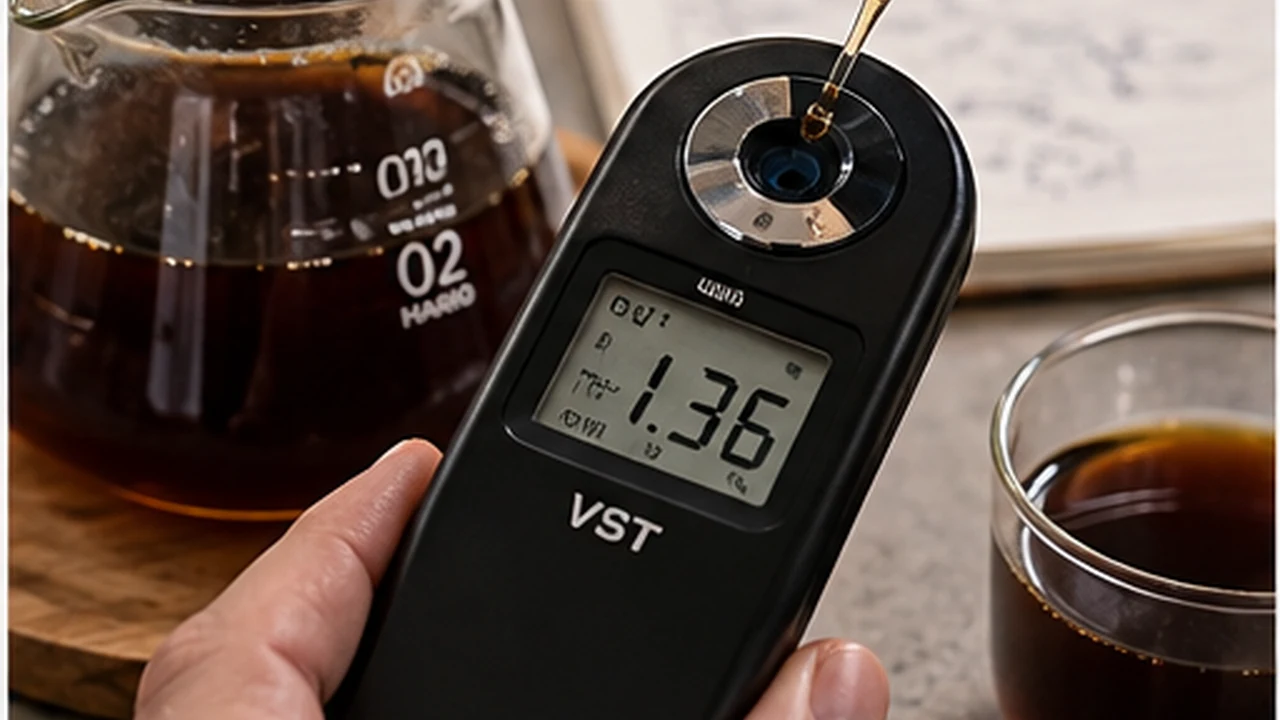
Total dissolved solids (TDS) is the percentage of the beverage made up of dissolved coffee material. If a refractometer reports 1.35% TDS, the remaining beverage is mostly water. TDS is therefore a measure of strength or concentration, not directly a measure of “how much was extracted” from the grounds.
What extraction yield means
Extraction yield estimates the percentage of the original dry coffee mass that ended up dissolved in the beverage. A simplified calculation combines beverage mass, TDS and dry dose. Because retained water and measurement technique matter, the exact workflow is important when comparing brews.
Connecting numbers to taste
A sour or hollow cup often benefits from more even or greater extraction: finer grinding, better saturation, adequate temperature, or longer contact time. A dry, harsh cup can indicate excessive extraction in parts of the coffee bed, channeling, too many fines or simply a roast profile you do not enjoy. Numbers narrow the search; they do not replace sensory judgment.
Why “extraction phases” are an approximation
It is tempting to divide brewing into neat stages — acids first, sweetness next, bitterness last — but real extraction is overlapping and continuous. Different compounds dissolve at different rates, yet flow, temperature and particle size make the process less tidy than a three-step chart suggests. Use phase models as teaching aids rather than literal chemistry clocks.
When a refractometer is useful
A refractometer is most valuable when you are testing systematically: same coffee, same water, same brewer, controlled technique. It can tell you whether a recipe changed strength and, with careful measurement, estimate extraction yield. For everyday brewing, a scale, timer and good notes deliver most of the practical benefit at far lower cost.
A simple diagnostic workflow
- Taste the cup after it has cooled enough to reveal sweetness and acidity.
- Identify the dominant problem: sharp/sour, hollow, dry/astringent, roasty, or simply too strong/weak.
- Separate strength from extraction. If flavor balance is good but strength is wrong, change ratio or dilution. If flavor balance is wrong, change extraction variables.
- Change one variable and repeat.
Worked calculation with a weighed cup
Suppose you put 20 g of dry coffee in a dripper, pour 320 g water and collect 280 g beverage. A correctly calibrated coffee refractometer reads 1.35% TDS. In a simplified filter-coffee calculation, dissolved material is 280 × 0.0135 = 3.78 g. Estimated extraction yield is 3.78 ÷ 20 × 100 = 18.9%. The calculation uses collected beverage mass, not 320 g poured, because the grounds and brewer retain water.
| Quantity | Example | How to obtain it |
|---|---|---|
| Dry coffee dose | 20 g | Weigh before brewing |
| Water poured | 320 g | Track separately; not beverage mass |
| Beverage collected | 280 g | Weigh the finished cup without the cup itself |
| TDS | 1.35% | Calibrated instrument and appropriate sampling |
| Approximate extraction yield | 18.9% | 280 × 0.0135 ÷ 20 × 100 |
This is an educational arithmetic example, not a measurement performed by this site. Espresso crema, sediment, sampling and device calibration can complicate the calculation; follow the instrument's procedure when precision matters.
Choose the adjustment according to the defect
If a cup is both weak and sour, there may be insufficient extraction, insufficient concentration, or uneven flow. Do not respond automatically by adding more coffee: that changes strength and puck/bed behavior together. First repeat the same recipe with an even pour or distribution. Then change grind only, keeping the same input weights.
If it tastes pleasantly balanced but watery, you can increase dose relative to water or use bypass and dilution experiments to locate your preferred concentration. If it is strong and bitter, decide whether you dislike roast character, excessive extraction, or simply the strength. A little dilution is an informative test because it modifies concentration without extracting more from the grounds.
Copy this four-brew log
Record coffee name and roast date; brewer and filter; dose, water input and beverage output; grind setting; water and temperature; total brew time; tasting notes while warm. Brew A is your baseline. For B, change grind only; for C, return to the baseline and change temperature only; for D, repeat the version you preferred to see whether the improvement is reproducible.
You do not need a refractometer to run the experiment: honest notes and measured inputs already distinguish a repeatable change from guesswork. Our ratio calculator helps keep dose and water coherent when changing batch size; the bypass recipe demonstrates dilution as a separate control.
References and editorial limits
Definitions and calculation methods should be checked against the documentation for your coffee refractometer and the Specialty Coffee Association's educational materials. Standard extraction ranges describe traditional filter-coffee conventions, not guarantees of deliciousness, health or product quality. No laboratory experiment or tasting result is claimed on this page.